
Can Polar Bears Swim?
Do you wonder how polar bears swim incredibly well? As powerful predators, their grace and speed in the water have led to animal scientists’ interest in what helps them swim magnificently.
In this blog post, we’ll explore the intricate systems working inside these masters of aquatic locomotion and learn why polar bears are some of the best swimmers on our planet. Read on to discover the fascinating physiological functions giving rise to this amazing feat.
Why Can Polar Bears Swim Incredibly Well?
Yes, polar bears can swim! They are powerful swimmers with many adaptations that help them swim well. Polar bears have large webbed feet with dense fur on the soles, which allows them to “paddle” through the water as they swim.
Their thick layer of fat also helps insulate them and keep them buoyant, so they can swim long distances without tiring. They have also been known to dive deep while hunting, reaching depths of up to 15 feet!
Can polar bears swim as effectively as other marine mammals?
Their unique adaptations certainly make them stand out. For instance, their huge size gives them a great advantage over smaller water animals as they can quickly cover long distances. Polar bears are also known for their excellent sense of smell, which helps them to locate prey underwater and navigate in darkness.

They can also close their nostrils when swimming to prevent water from entering their lungs. All these features combined make polar bears some of the best swimmers in nature. Even so, polar bears expend energy when swimming and can tire quickly. They usually swim for up to 30 minutes and must often rest to conserve their energy. In addition, they need to be careful not to overexert themselves, as this could cause hypothermia or exhaustion.
How Far Can a Polar Bear Swim?
In the face of climate change, understanding how far a polar bear can swim becomes really important. Some reports say that polar bears have swum up to 60 miles (96 km) without stopping. This shows just how strong and enduring they are, allowing them to travel long distances in the Arctic to find food. However, recent research has found that polar bears can swim even farther than that.
Studies have shown that polar bears can swim from 51 km to 404 km, with the average swim lasting about 3.4 days. In some extreme cases, they’ve been seen swimming as far as 687.1 km over almost 10 days. That’s like swimming from New York City to Washington, D.C.!
However, this isn’t easy for them. Swimming is much more exhausting for polar bears than walking. Their bodies use up a lot of energy when they swim, about five times more than when they walk. This is especially hard on smaller bears and those that aren’t in great shape because they lose heat faster than they can make it.
Long-distance swims also greatly impact their survival and ability to have cubs. These extended swims are physically exhausting and can lead to higher death rates, especially among younger and older bears. For example, there was a case where a female polar bear swam continuously for 687 km, losing 22% of her body mass and her cub during the journey. As climate change continues and sea ice keeps shrinking, these long swims are becoming more common, putting more stress on polar bear populations.
Understanding how far polar bears can swim and the toll it takes on them is crucial, especially as climate change continues to reduce sea ice. While their endurance is impressive, these long swims take a lot of energy and increase their risk of dying, making it even more important to focus on conservation efforts.
How Fast Can a Polar Bear Swim?
Now, let’s not forget about speed. How fast can a polar bear swim? While they might not match the speed of some marine animals, they can still swim at an impressive pace. Actually, polar bears can reach up to 6 miles per hour (9.7 kilometers per hour). This speed is essential for catching their prey and moving swiftly through their aquatic environment.
That might not seem incredibly fast swimming compared to some marine animals, but for a land mammal, it’s quite remarkable. Their large, powerful limbs act like paddles, propelling them through the water efficiently. This swimming speed is crucial for their survival. It allows them to cover large distances in search of food and helps them catch their prey, mainly seals, which are also excellent swimmers.
Additionally, their swimming speed showcases polar bear adaptability. They can swim for several hours without getting tired, making them one of the most proficient swimmers among land mammals. This skill is especially important as climate change causes ice to melt, forcing polar bears to swim longer distances between ice floes. Thus, knowing how fast polar bears swim underscores their efficiency as predators in the water, complementing their hunting skills on land.
Why are Polar Bears Excellent Swimmers?
The answer is simple: Polar bears have large, webbed paws. The webbing acts as paddles, allowing them to move quickly through the water. Polar bears have a layer of fat and fur that keeps them warm even in icy waters. Their front feet are also equipped with sharp claws that help them catch prey such as fish or seals.
Additionally, thick layers of fat beneath their skin provide optimal buoyancy. This combination of large webbed feet, dense fur, and fat, along with their ability to regulate body temperature, make them incredibly efficient swimmers.
Polar bears can use all four limbs for swimming, providing them with more incredible speed and maneuverability than other bears. They typically travel in a straight line, using their powerful front legs to push off the bottom of the water. They can remain underwater for up to two minutes, allowing them to hunt prey or take a break from swimming.
Polar bears can swim incredibly well due to their unique physical adaptations. Their large webbed feet and thick layers of fat make them powerful swimmers, while their sharp claws help them catch prey. Additionally, they can uniquely regulate their body temperature in icy waters. All these elements combine to make polar bears some of the best swimmers in the animal kingdom.
How Long Can Polar Bears Hold Their Breath?
Polar bears can hold their breath underwater for up to 2 minutes. They use this technique when hunting prey and diving deep into the water for food. The bear’s large lungs also help it stay underwater for extended periods. In addition to holding their breath when diving in the Arctic Ocean, polar bears are known for their strong swimming abilities and can swim up to 10 km/h (6mph).
Regarding air, polar bears can also hold their breath for extended periods. They can remain submerged in a single breath-hold dive for up to 3 minutes and 20 seconds, although they usually come back up for air every 30-60 seconds when hunting. Scientists believe the bear needs to keep its heart rate low to conserve energy and oxygen. This is why they are such great predators at sea – they can easily catch their prey with their powerful swimming skills.
What Makes Polar Bears Great Swimmers?
Polar bears are like the Olympic swimmers of the Arctic. Ever wondered why? Well, their bodies are custom-built for life in the water. Their eyes stick out more than usual, giving them great underwater vision, and their small ear openings cut down on drag when they’re gliding through the icy seas.
These incredible bears can swim for miles and even dive up to 1.5 miles underwater to snag their next meal. And here’s a cool fact: their thick fur isn’t just for show. It’s made of hollow hairs that trap air, keeping them toasty warm even in freezing water.
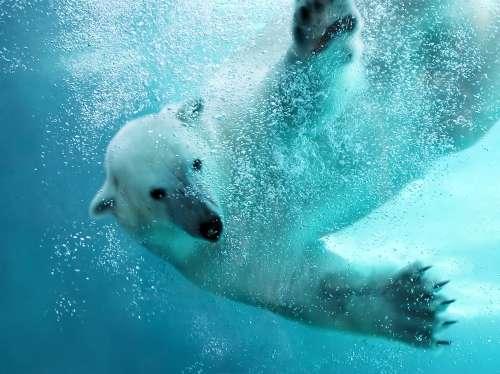
Polar bears have webbed feet that act like natural flippers, giving them control and speed in the water. They steer with their front paws, making powerful strokes, while their back legs work like paddles. It’s like they’ve got their own built-in swim team!
Their bodies are perfectly shaped for buoyancy, with a thick layer of fat that keeps them afloat and insulated. Unlike most land animals, polar bears spread their toes wide when they swim, giving them even more control.
When it’s time to dive, they push off the sea floor with their hind legs and use their front paws to swim fast and far. This helps them dodge predators and cover vast distances with ease.
And let’s not forget their fur coats! They have two layers: a waterproof top layer and a super- insulating undercoat. This, combined with a fat layer under their skin, keeps them warm and helps them float. It’s no wonder they thrive in the harsh, cold Arctic environment.
Conclusion
I hope this article has provided some insight into how polar bears can swim so well. Polar bears have adapted their bodies, through physical and behavioral adaptations, to become the expert swimmers they are today. Their thick fur and fat layer helps them stay warm in the cold arctic waters, while their paddle-like front feet provide plenty of power in their strokes. Polar bears also use their large lungs to store oxygen and maximize their strength while swimming. All of these adaptations work together to create a powerful swimmer that can remain active in the cold arctic waters.
Want to learn more?
Polar Bear Gifts